
Company
Why now
The models stopped being the constraint. Governance became it. That reversal is the reason this company exists in 2026 rather than in 2019, and it is the reason we lead with a gate rather than with a demo.
- 98%Of companies have deployed AI agents or plan to.SAP LeanIX survey, 2026
- 150,000+AI agents expected at the average Fortune 500 enterprise by 2028.Gartner estimate
- 13%Of those organisations believe they have adequate governance for them.Gartner
- 150+Organisations behind the A2A protocol, with production use in IT operations.Linux Foundation, April 2026
What actually changed
Four constraints lifted, and none of them alone was enough
People usually answer this question with one sentence about models getting better. That is the least interesting part of it. Four separate things moved, on roughly the same timetable, and it is the combination that makes governed autonomous operations buildable now and not five years ago.
Reasoning stopped being the bottleneck
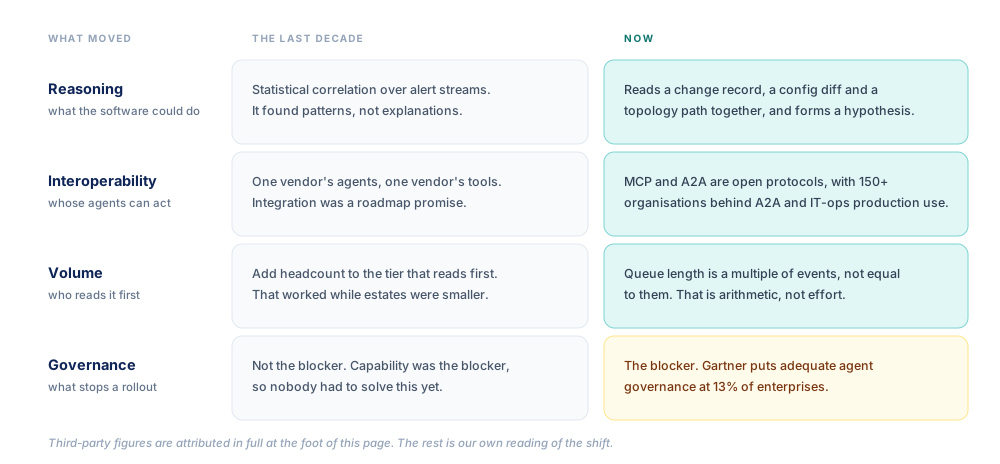
For a decade this field meant statistical correlation over alert streams: it found patterns, not explanations. Reading a change record, a config diff and a topology path together and forming a hypothesis is now routine. So the hard question moved from can it reason to will you let it act.
Agents stopped belonging to one vendor
MCP and A2A turned interoperability from a roadmap promise into a protocol, with more than 150 organisations behind A2A and production use in IT operations. No serious enterprise was ever going to let a single vendor own every action on its estate.
Volume outran the hiring model
One failing component still produces alerts in every tool that watches it, so queue length is a multiple of events rather than equal to them. That is an arithmetic problem, not an effort problem, and the people who used to absorb it are the ones handing in notice.
Governance became the blocker
Anyone can demo an agent that fixes something. Almost nobody can answer what happens when it is wrong. Gartner puts adequate agent governance at thirteen percent of the enterprises heading toward six figures of agents each. That gap is the whole market.
The shift, side by side
The same four things, before and after
Read the right-hand column as the reason the left-hand column stopped being the right way to build this. Every figure quoted belongs to somebody else and is attributed at the foot of the page. The reading of what it means is ours, and you are free to disagree with it.
Our position
Everyone is now solving the wrong half of it
The industry response to the governance gap has largely been to attach a confidence score to the diagnosis and call that a control. We think that is the wrong gate, and it is the specific reason we built the platform the way we did.
A confidence score describes the diagnosis, not the consequence
A model can be ninety-nine percent certain about a change that drops every session in the estate, and unsure about a pod restart that cannot hurt anyone. Gating on confidence means the size of your worst outcome is set by how certain a model felt, which is not a control anyone can write into a change policy.
So we gate on the blast radius of the action instead. That is a property of what the action touches, which means a change advisory board can review it, argue with it and write it into policy in language they already use.
Waiting does not de-risk it, it just moves the start date
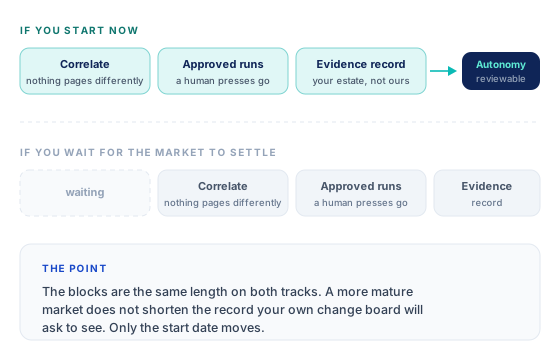
The argument for waiting is that the market will settle and the tooling will mature. Both are probably true. Neither shortens the part that actually gates your rollout, which is the record of your own actions running under approval on your own estate, because that is what your change board will ask to see.
That record takes the same time to build whenever you start it. A more mature market does not compress it. This is the only urgency argument we think is honest, and it is a much quieter one than the industry usually makes.
How autonomy is granted per actionWhat phase one actually involves
Being straight with you
What we are not going to claim
Questions we get asked
Frequently asked questions
Is this not just the AIOps pitch from 2018 with better models?
The 2018 pitch was about detection: collapse the noise, find the pattern, hand a human a shorter list. That was correlation, and correlation is necessary rather than sufficient. What is different is not the quality of the detection, it is that software can now take the action and that the interesting problem became who is accountable when it does. A better model does not answer that question. A governance model does.
Why would we not wait for the market to consolidate?
You might well be right to. The one thing waiting does not shorten is the record of your own actions running under approval on your own estate, and that is what your change board will ask to see before it grants any autonomy. That record takes the same time to build whenever you start it. If the market consolidating matters more to you than that clock, waiting is a defensible call and we will say so.
Do the agent protocols actually matter, or is that just standards noise?
They matter for one specific reason: they decide whether the platform orchestrating your operations has to be the platform that ships every agent. A2A passed 150 supporting organisations in its first year under the Linux Foundation, with production deployments including IT operations. That means an orchestrator can task an agent your own team built, or one a managed-service provider brought, without either side owning the other. Before that, multi-vendor agentic operations was a slide.
You are quoting analyst forecasts. Are those reliable?
They are estimates about the future and we have labelled them as such rather than presenting them as measurements. We use them for one narrow purpose: to show the gap between how many agents enterprises expect to run and how many of them believe they can govern those agents. The direction of that gap is the argument, not the precision of the number. Every figure on this page is attributed below so you can go and read the source yourself.
What makes you the right people to be doing this now?
That is a fair question and it is not one a market-timing page can answer. It is answered by what we have actually deployed and what we refuse to claim, both of which are on this site with the basis stated on every figure. The case studies are the honest version of that answer.
Sources
Where the third-party figures come from
Every number on this page that is not ours is listed here with its source, so you can check it rather than take our word for it. Analyst projections are forecasts about the future, not measurements of the present, and we have marked them that way throughout.
- Gartner, on the expected number of AI agents at the average Fortune 500 enterprise by 2028 and the share of organisations that believe they have adequate governance for them. Reported by SAP News Center, August 2026. Forecast, not a measurement.
- SAP LeanIX Agentic AI Survey 2026, on the share of companies that have deployed AI agents or plan to, and on agent inventory visibility. Reported in the same piece. Survey of stated intent.
- The Linux Foundation, on the A2A protocol passing 150 supporting organisations in its first year, its integration into major cloud platforms, and production deployments spanning supply chain, financial services, insurance and IT operations. Press release, April 2026. Counted, not forecast.
- Everything else on this page is our own argument, and our own deployments are recorded in the case studies with the basis stated for each figure.
Go deeper
Where to read next
- SolutionGoverned Autonomous ExecutionThe gate itself: how an action earns the right to run alone, and which ones never will.
- CompanyWhy UsOne closed loop across every domain, and what that means against a stack of point tools.
- EvidenceRecorded deploymentsWhat we have actually run in production, with the basis stated on every figure.
Start the record, not the rollout
Phase one changes nothing about what pages you. It correlates your signals and shows you what the platform would have delivered against what actually got delivered. That comparison is the only honest basis for deciding whether any of this is worth doing on your estate.