
By role
For the CIO and VP Infrastructure
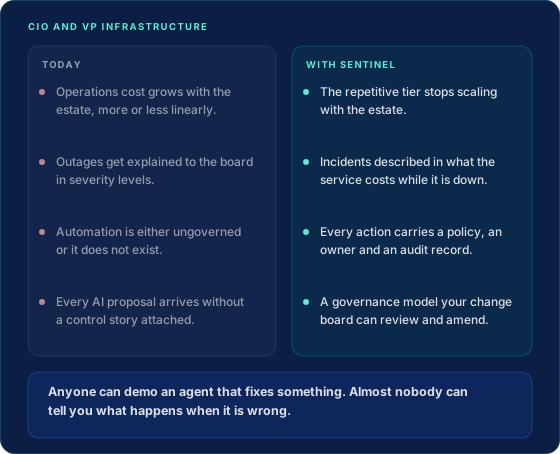
The question in front of you is not whether AI can diagnose an incident. It is whether anyone can tell you what happens when it is wrong, and whether that answer survives contact with your change board and your auditor.
- Per actionAutonomy is granted one action at a time, on what it can break, never as a platform-wide switch.The control you retain
- Blast radiusThe size of your worst outcome is set by a policy you wrote, not by how certain a model felt.What bounds the risk
- AuditablePre-check, post-check, rollback and a named owner on every action, recorded identically.What survives an audit
- ApprovalEvery procedure in the shipped library still requires a human. Nothing arrives switched on.What we do not sell
What actually costs you
Three things, and none of them is a tooling gap
These are the problems we hear described in the same words on almost every estate. Each one is structural rather than a failure of effort, which is why buying another point tool has not fixed them.
The cost curve is the strategic problem
Operations spend rises with estate size because the tier that reads everything first rises with it. That is an arithmetic relationship, and no procurement round or managed-service contract changes the shape of it, only who pays for it.
Governance is now the blocker, not capability
The models became good enough some time ago. What stops a rollout is that nobody can answer four questions: which actions may run, what each can break, who owns it, and what the record looks like afterwards. Those are change-management questions.
An outage explained in severity levels tells the board nothing
P1 is an internal grammar. What a service costs the company per hour while it is unavailable is a number your board already reasons in, and almost no operations tooling is set up to produce it.
What changes
The two decisions that matter for your role
The mechanism is the same across the platform and is set out on the solution pages. What is worth your time here is how it lands on the specific work you are accountable for.
What your change advisory board actually reviews
Not a claim about a model. A policy about actions: which are permitted to run unattended, inside what radius, with which pre-check asserted, verified how, reversible by what path, owned by whom.
Every one of those is a property of the action rather than of the AI, which means it can be argued with, amended and written into your existing change process rather than requiring a new one.
What you can put in front of a regulator
An action trail recorded as the work happened: what was observed, which hypotheses were tested, which procedure ran, who approved it, what the post-check proved against live signals, and what remains open.
Findings carry citations back to the change record, counter or log line behind them, which means the analysis can be checked rather than believed.
See it on a real fault
Four walkthroughs from your side of the desk
Each one follows a specific fault end to end: what arrived, what was correlated, what ran and where the boundary of autonomy sat.
- Service OpsThe CAB meeting where nobody can score the riskRead the walkthrough →
- Managed OpsThe batch failed and took eleven jobs with itRead the walkthrough →
- Security OpsA privileged login at 02:14, from a jump host nobody recognisesRead the walkthrough →
- Service OpsThe SLA breached while the ticket sat in a queueRead the walkthrough →
Being straight with you
What we are not going to claim
Questions we get asked
Frequently asked questions
What is the actual risk if this goes wrong?
Bounded by the blast radius policy you wrote, which is the point of gating on consequence rather than confidence. Anything carrying service impact is held for a named owner, and an action with no viable rollback is not eligible to run unattended at all. The worst case is a decision you made in advance, not one a model made at three in the morning.
How does this get past our change advisory board?
By giving them something they already know how to review. The gate is a policy about actions, expressed in terms of what each action touches, who owns it and how it is reversed. That is the language your change process is already written in.
What is the honest timeline to value?
Phase one turns correlation on with nothing paging differently, which produces a comparison against your own baseline almost immediately. Approved procedures follow. Autonomy is the third phase, granted per action on the evidence from the second, and some actions never qualify.
Can it run inside our perimeter?
Yes. The execution engine, the audit store and the reasoning layer all run inside the customer perimeter with no egress required, which is the deployment model most regulated estates require.
Go deeper
Where to read next
Bring us the action you would never let software take
We will walk it through the gate with you: what it can break, what its pre-check would assert, what its post-check would have to prove, and whether it should ever run alone. If the answer is that it should not, we will say so.