
By role
For Incident Management
The first twenty minutes of every bridge call goes on establishing what is actually happening. That time is not judgement work, it is reconstruction, and it is the part of your process that software should have taken years ago.
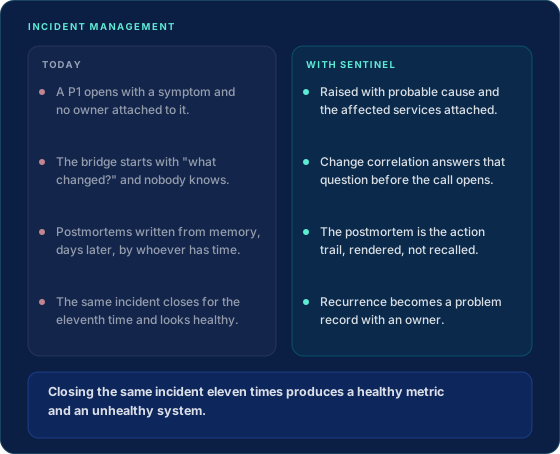
- Before the pageInvestigation runs before anyone is notified, so the bridge opens with a case rather than a question.How the loop is ordered
- CitedEvery claim in the analysis links to the change record, signal or log line behind it.What you can hand to review
- From the trailThe postmortem is generated from what happened, not reconstructed from what people remember.How it is assembled
- Eleventh timeRecurring signatures are promoted into problem records rather than closed again.Problem detection
What actually costs you
Three things, and none of them is a tooling gap
These are the problems we hear described in the same words on almost every estate. Each one is structural rather than a failure of effort, which is why buying another point tool has not fixed them.
The first twenty minutes are archaeology
Who owns this, which alerts are one event, what changed, has it happened before. Four questions, every incident, answered by people reading consoles while the clock runs. None of it is the judgement your major incident manager is actually there for.
Postmortem debt is invisible until an audit
Written days later from memory and chat scrollback, when the people involved have moved on to the next thing. What gets recorded is what somebody remembered, which is not the same as what happened.
Repeat incidents look like good performance
Eleven fast closures beat one long investigation on every dashboard you are measured against. The metric rewards exactly the behaviour that leaves the cause in place.
What changes
The two decisions that matter for your role
The mechanism is the same across the platform and is set out on the solution pages. What is worth your time here is how it lands on the specific work you are accountable for.
SLA breach is predictable before it is reportable
A ticket sitting in a queue is a measurable trajectory, not a surprise. Time remaining against the commitment, the current queue position and the historical time-to-resolve for that signature are all knowable while there is still room to act.
Predicting the breach is only useful if something can be done about it, which is why the prediction arrives attached to the owner, the probable cause and, where one exists, an approved procedure.
The eleventh time is a problem, not an incident
Signatures that recur are promoted out of incident management into a problem record with its own owner. That is a deliberate change in where the work sits, because incident process is built to restore service and is not built to remove causes.
It also makes the recurrence visible to people who were never going to read eleven separate closure notes.
See it on a real fault
Four walkthroughs from your side of the desk
Each one follows a specific fault end to end: what arrived, what was correlated, what ran and where the boundary of autonomy sat.
- Service OpsThe SLA breached while the ticket sat in a queueRead the walkthrough →
- SherlockThe same incident, for the eleventh time this quarterRead the walkthrough →
- Managed OpsThe batch failed and took eleven jobs with itRead the walkthrough →
- Service OpsThe quote is stuck and sales does not know whyRead the walkthrough →
Being straight with you
What we are not going to claim
Questions we get asked
Frequently asked questions
Does this replace our incident management tool?
No. The platform writes into ITSM through native connectors rather than asking anyone to work somewhere new. The correlation, the cited analysis and the action trail attach to the record you already run your process on.
How does it decide severity?
Services and processes carry a business impact value, so priority can be argued in terms of what the outage costs rather than in severity levels that mean nothing outside operations. That is a separate measure from blast radius, which governs what an action is allowed to do.
What if the automated analysis contradicts our engineers?
Then your engineers check the citation rather than the conclusion, which takes seconds. The design assumes disagreement: every verdict states what evidence would change it, precisely so a dispute is about a specific artefact instead of about whose judgement to trust.
Can we still write our own postmortems?
Of course, and many teams should. What changes is the starting point: instead of an empty document and a chat log, you begin from a record of what was observed, what was tested, what ran, who approved it and what was verified.
Go deeper
Where to read next
- SolutionCited RCA and PostmortemWhy an analysis nobody can check is an opinion with a timestamp.
- SolutionIncident Triage and CorrelationWhat the event carries by the time it reaches your process.
- SolutionGoverned Autonomous ExecutionWhy a failed post-check fires a rollback instead of closing a ticket.
Bring us a P1 that took too long to understand
Not to fix, to understand. We will walk through what would have been attached to it at the moment it was raised, and how much of that first twenty minutes was reconstruction.