
By role
For Managed Service Delivery
Your margin is a function of how many engineers it takes to hold a customer to their SLA. That is the number the repetitive tier moves, and it is the only one your finance director is actually watching.
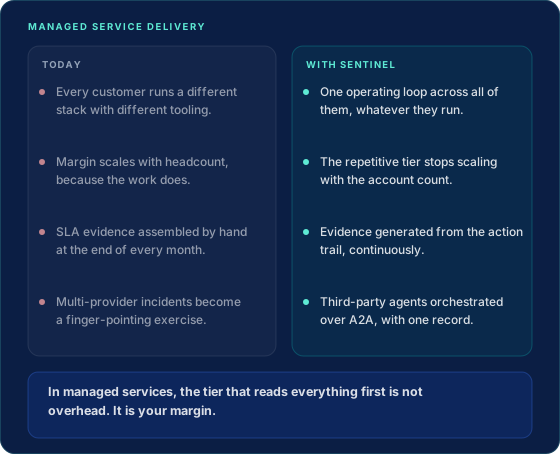
- Any stackOne loop over whatever each customer runs, rather than one integration project per account.How it scales across accounts
- A2A and MCPAgents you did not build and tools you do not own, tasked under one orchestrator.Multi-provider by design
- From the trailSLA and action evidence generated continuously rather than assembled at month end.What you show the customer
- Per tenantBlast radius policy is written per customer, because their change appetites are not the same.How governance stays theirs
What actually costs you
Three things, and none of them is a tooling gap
These are the problems we hear described in the same words on almost every estate. Each one is structural rather than a failure of effort, which is why buying another point tool has not fixed them.
Margin is headcount, and headcount is the reading tier
Every account you add brings alerts that somebody has to read, correlate and route before anyone does anything skilled. That work scales linearly with accounts and it is the reason margin does not improve with size.
Proving the SLA costs almost as much as meeting it
Month-end evidence assembly is manual, retrospective and disputed exactly when a customer is unhappy. The data existed all along; nobody had a system of record designed to produce it as a by-product.
Multi-provider incidents have no owner
When a fault crosses your boundary into another provider, the incident becomes a conversation about whose fault it is. Both sides have partial evidence, neither has the whole path, and the customer watches the clock run.
What changes
The two decisions that matter for your role
The mechanism is the same across the platform and is set out on the solution pages. What is worth your time here is how it lands on the specific work you are accountable for.
Orchestrating agents you did not ship
A managed estate always has other people’s automation in it: the customer’s own agents, another provider’s tooling, systems you inherited. Agent-to-agent protocol lets the orchestrator task those directly, and Model Context Protocol lets it call tools the platform does not own.
That is the difference between coordinating providers in a conference call and coordinating them in a system that keeps one record of who did what.
Evidence a customer will actually accept
Every action carries a pre-check result, a post-check verdict, a rollback path and a named owner, recorded identically every time. SLA reporting stops being an assembly exercise and becomes a query against a record that was written as the work happened.
It also changes the tone of a difficult review, because the evidence was not produced by the party being questioned about it after the fact.
See the orchestration proof of conceptHow every action is recorded
See it on a real fault
Four walkthroughs from your side of the desk
Each one follows a specific fault end to end: what arrived, what was correlated, what ran and where the boundary of autonomy sat.
- Managed OpsThe batch failed and took eleven jobs with itRead the walkthrough →
- Service OpsThe SLA breached while the ticket sat in a queueRead the walkthrough →
- Service OpsTwo hundred ATM tickets, one upstream causeRead the walkthrough →
- SherlockThe same incident, for the eleventh time this quarterRead the walkthrough →
Being straight with you
What we are not going to claim
Questions we get asked
Frequently asked questions
Can it run across customers with completely different tooling?
That is the case it was built for. The platform ingests from whatever each customer already runs and normalises it into one shape, so the loop is the same even when the underlying stacks are not. It avoids the integration project per account that usually kills the economics.
How do we keep each customer’s governance separate?
Blast radius policy is written per tenant. What one customer permits to run unattended has no bearing on another, and the audit trail is scoped the same way, because their change appetites and their regulators are not the same.
What about agents and tools another provider owns?
Those are reachable over agent-to-agent protocol and Model Context Protocol respectively. The orchestrator can task an agent it did not ship and call a tool it does not own, which is what makes a genuinely multi-provider incident tractable.
Does this let us take on accounts we would otherwise decline?
Possibly, and that is the honest answer rather than the confident one. It depends on whether the work in those accounts is repetitive enough to move into procedures. We would want to look at the alert history before saying yes.
Go deeper
Where to read next
Bring us your least profitable account
The one where the SLA is met by effort rather than by design. We will walk through which of that effort is genuinely repetitive and what moving it into governed procedures would involve.