
Solution
L2, L3 and SRE Augmentation
Senior engineers are not slow at fixing things. They are slow at reaching the point where fixing is possible, because the first stretch of every incident goes on rebuilding context that already existed in six systems.
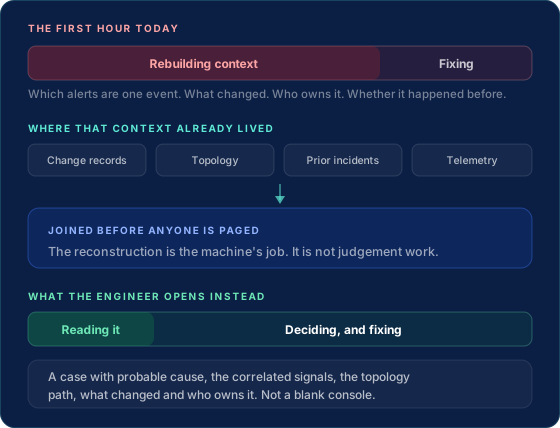
- Before the pageThe reconstruction happens first, so the engineer opens a case rather than a blank console.How the loop is ordered
- CitedEvery claim in an investigation links back to the record, signal or log line behind it.On every finding
- It refusesWhere an action sits outside its permitted radius, the platform proposes nothing and says why.A design property, not a limit
- Plain languageAsk what changed in the last two hours and get an orchestrated investigation, not a search result.Co-Pilot as a trigger
What it changes
What augmenting the senior tier actually buys you
L1 is a volume problem. L2, L3 and SRE is a depth problem, and the two need different answers. The expensive part here is not the fix. It is everything that has to be true before anybody can propose one.
Stop paying senior time for reconstruction
Working out which alerts are one event, what changed, who owns the service and whether this has happened before is mechanical work. It repeats on every incident and it rewards nobody. It runs before the page instead.
Argue with the evidence, not the author
Every clause in a finding carries a citation: the change record, the counter, the log line. A senior engineer can disagree with a specific piece of evidence in seconds rather than re-deriving the whole chain to check it.
Answer what changed, in one question
Change correlation reaches across CMDB, delivery pipelines and configuration. The question every incident bridge opens with stops being a twenty minute exercise in four browser tabs.
Keep the reasoning, not just the outcome
The investigation trail records which hypotheses were tested and which were dropped, not only what was concluded. That is the part of an expert's thinking that normally leaves with them.
How it works
Ask in plain language, get an orchestrated investigation
Co-Pilot is not a search box over your logs. A question dispatches an investigation across change records, topology, prior incidents and telemetry, and what comes back is a finding with its citations attached and an explicit statement of what the platform will not do about it.
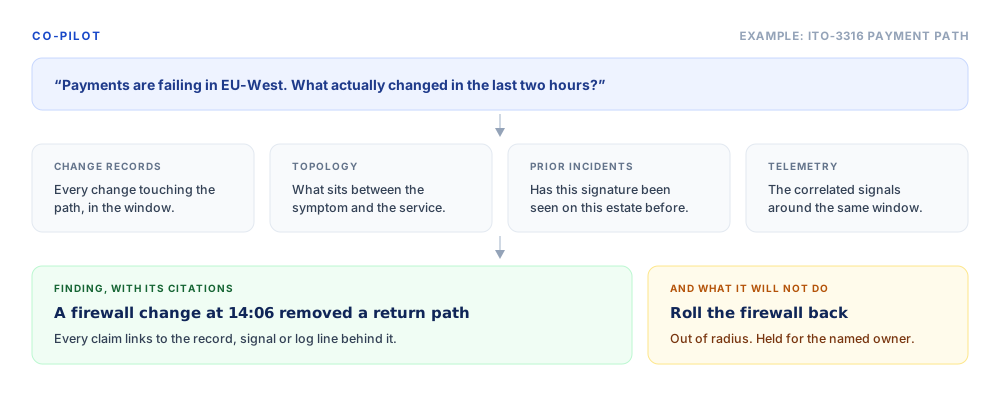
The part vendors skip
A system that only ever agrees with you is not an assistant
Augmentation is easy to demo and hard to trust. The difference shows up in what the platform does when it is not sure, and in what it declines to touch even when it is.
It refuses, and it says why
When a proposed fix sits outside its permitted blast radius, the platform does not quietly propose something weaker. It states the action it would take, states that the action is out of radius, and holds it for the named owner with the plan and the rollback attached.
An SRE who has been handed one confidently wrong recommendation stops trusting the next fifty. The refusal is what makes the acceptances worth reading.
Verification is a separate job from execution
The component that runs a fix is not the component that decides whether it worked. Sherlock checks the outcome against live signals rather than against an exit code, and it is built to return a verdict nobody wanted, including that the symptom cleared while the cause stayed open.
Separating those two roles is the reason an SRE can read a closed ticket and believe it.
How blast radius gates an actionHow verification and citation work
See it on a real fault
Four investigations this describes
Each one walks a specific fault end to end: what arrived, what was correlated, what the investigation found and where the boundary of autonomy sat.
- Service OpsSomething is slow. Nobody can say which something.Read the walkthrough →
- Service OpsThe CPU spiked at 3am and the pager did its jobRead the walkthrough →
- Service OpsThe switch was fine. The cut-off wasn't.Read the walkthrough →
- Data OpsThe connection pool ran out and took checkout with itRead the walkthrough →
Being straight with you
What we are not going to claim
We have a recorded proof of concept in which Co-Pilot chat was demonstrated as a first-class trigger, producing an orchestrated investigation and an automated postmortem from the action trail. That is a demonstrated trigger path, not a measured reduction in senior engineering time, and we are not going to present it as one.
Questions we get asked
Frequently asked questions
How is this different from an AI assistant bolted onto our observability tool?
An assistant scoped to one tool can only reason over that tool's data, which means it cannot answer the question every incident actually opens with: what changed. Change lives in CMDB, in pipelines and in configuration, not in telemetry. The investigation here is dispatched across those systems as well as the signals, which is also why it can cite a change record rather than infer one.
Will it propose something wrong and waste our time?
Sometimes it will be wrong, and the design assumes that. Every claim carries the evidence behind it so a senior engineer can check the weak link rather than re-derive the chain, and the platform states explicitly what it will not act on and why. A system that never expressed doubt would be far more dangerous than one that occasionally proposes a bad hypothesis with its reasoning attached.
Does it need our runbooks to be written down first?
Not for investigation. Correlation, change attribution and cited findings work against the signals and records you already produce. Written procedures are only needed once you want the platform to act, and that is a separate decision gated per action on blast radius.
What happens to the investigation when the incident closes?
It becomes the postmortem, generated from the action trail rather than reconstructed from memory afterwards. Recurring signatures are promoted into a problem record with an owner, because closing the same incident eleven times produces a healthy-looking metric and an unhealthy system.
Go deeper
Where to read next
- SolutionCited RCA and PostmortemWhy an analysis nobody can check is an opinion with a timestamp.
- SolutionIncident Triage and CorrelationWhat has to be true before an investigation is even worth starting.
- SolutionGoverned Autonomous ExecutionHow an action earns the right to run, and which ones never will.
Bring us the incident your best engineer had to be woken for
We will walk through what the reconstruction would have produced before the page went out, which parts of it the platform could have cited, and where it would have stopped and asked for a human.